
How to Replace a Lost Car Title in the USA (Complete Step-by-Step Guide)
Blog post description.
1/3/202616 min read
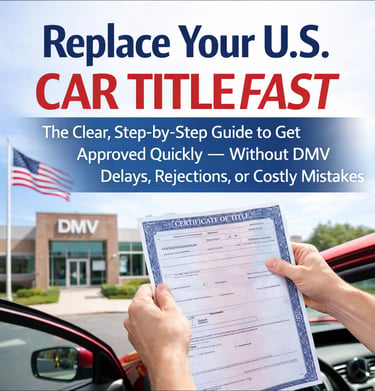
How to Replace a Lost Car Title in the USA
The Complete Step-by-Step Guide to Getting Your Vehicle Title Reissued Fast (Without Costly Mistakes)
Losing your car title doesn’t feel like an emergency… until the moment you try to sell, trade, donate, insure, register, or move your vehicle.
Then everything stops.
No title means:
You can’t sell the car
You can’t transfer ownership
You can’t legally junk it
You can’t prove it’s yours
You can’t even complete most DMV transactions
And if you wait too long, the problem gets worse — not better.
Thousands of Americans every month discover they “lost” their car title years ago… right when they urgently need it. And because every state runs its own DMV system, the process can feel confusing, slow, and unforgiving.
This guide shows you exactly how to replace a lost car title in the United States — step by step — whether you live in California, Texas, Florida, New York, or any other state.
You will learn:
What a car title actually is and why it’s legally powerful
What happens when it goes missing
How to replace it even if the car is old, paid off, or was bought in a private sale
What to do if there is still a lien on the vehicle
How long it takes in each situation
How to avoid the most expensive mistakes people make
How to get your duplicate title as fast as possible
This is not generic DMV advice.
This is the real-world playbook Americans use to get their vehicle titles reissued quickly and legally.
Why Your Car Title Is More Important Than Your Registration
Most people confuse three documents:
Your registration
Your insurance card
Your title
Only one of them proves legal ownership.
That is the title.
Your car title is a state-issued legal certificate that identifies:
The vehicle (VIN, make, model, year)
The legal owner(s)
Any lienholder (bank, lender, finance company)
Whether the vehicle is salvage, rebuilt, or clean
Registration just proves the vehicle is allowed to be driven.
Insurance just proves it is insured.
Neither proves you own it.
If your car is stolen, sold, seized, or disputed, the title is what courts, DMVs, insurers, and buyers rely on.
When it’s gone, you lose control.
What Happens When Your Title Is Lost, Stolen, or Destroyed
A missing title creates a silent legal problem that can explode at the worst possible moment.
Here is what happens in real life:
You go to sell your car
The buyer asks for the title
You realize you don’t have it
Now you’re stuck.
You cannot complete a legal transfer without a title.
If the title was:
Lost in a move
Destroyed in a fire or flood
Thrown away by accident
Taken by an ex-spouse
Stolen
Never received after paying off a loan
The solution is the same.
You must apply for a duplicate title (also called a replacement title).
And until that title is issued, the car is legally frozen.
Who Is Allowed to Replace a Lost Car Title
Only one person can request a duplicate title:
The legal owner listed on the last issued title.
Not:
Your spouse (unless they’re listed)
Your kid
Your friend
The buyer
The mechanic
The tow yard
The dealer
If you are not the titled owner, you must first become the legal owner before a replacement can be issued.
That’s why buying a car without a title is dangerous — and why many people get trapped.
Step 1: Determine Who Holds the Current Title
Before you do anything else, you must answer one question:
Who is the title legally issued to right now?
There are only three possibilities:
You hold the title
A lienholder holds the title
Someone else holds the title
Let’s break this down.
If You Paid Off a Car Loan
Many states do NOT automatically send you the title after you pay off a car.
The bank may still be holding it.
You must check:
Look at your loan payoff documents
Call the lender
Ask: “Was the title released and sent to me or to the state?”
In some states, the bank sends the title to you.
In others, they send it to the DMV.
If the lender still holds it, you cannot apply for a duplicate until they release the lien.
If You Bought the Car From a Private Seller
If they never gave you a title, then YOU do not yet legally own the vehicle.
You must contact the seller to get a signed title or pursue a bonded title process.
More on that later.
If You Had the Title But Lost It
Then you are eligible to request a replacement.
Step 2: Check Your State’s DMV System
Every state runs its own motor vehicle system.
But the core process is the same everywhere:
You file an application
You prove identity
You pay a fee
They issue a duplicate title
However, the forms, fees, and waiting times vary.
Here are the official agencies by region:
California – DMV
Texas – TxDMV
Florida – FLHSMV
New York – NY DMV
Illinois – Secretary of State
Pennsylvania – PennDOT
Georgia – DDS
Ohio – BMV
You must apply in the state where the vehicle was last titled.
Not where you live now.
Not where you bought it.
The title lives with the state.
Step 3: Get the Correct Duplicate Title Form
Every state has a specific form.
It is usually called something like:
“Application for Duplicate Title”
“Request for Replacement Certificate of Title”
“Duplicate Title Application”
Examples:
California: REG 227
Texas: Form VTR-34
Florida: HSMV 82101
New York: MV-902
Using the wrong form will delay everything.
Download it directly from your state DMV website.
Step 4: Complete the Application Correctly
This is where most people screw up.
The form will ask for:
Vehicle information
VIN
Year, make, model
Your name exactly as it appears on the old title
Your address
Your driver’s license or ID number
Lien information
Odometer (in some states)
Signature
Every field matters.
If your name changed due to marriage or divorce, you must submit proof.
If there was a lien, it must be listed even if paid off.
If the VIN is wrong by even one digit, your request can be rejected.
Step 5: Provide Proof of Identity
You must prove you are the titled owner.
This usually requires:
Driver’s license or state ID
Sometimes notarization
Sometimes additional documents
Some states allow online requests.
Others require mail or in-person submission.
If the form requires notarization, do NOT skip it.
A missing notary stamp can cost you weeks.
Step 6: Pay the Duplicate Title Fee
Fees are surprisingly low.
Most states charge between $10 and $25.
Some charge extra for expedited processing.
Do NOT use third-party services unless you are stuck — the DMV does this cheaper and safer.
Step 7: Wait for Processing
Standard processing time:
2 to 6 weeks in most states
Expedited:
5 to 10 business days (where available)
Your title will be mailed to the address on file.
What If There Is a Lien on the Vehicle?
This is where things get tricky.
If a lender is listed on the title, the DMV cannot issue a clean duplicate.
You must get a lien release.
Contact the lender.
Request a lien satisfaction letter.
Submit it with your application.
If the lender no longer exists, you may need to file additional affidavits.
What If You Never Received the Title?
This happens when:
The dealer never submitted paperwork
The seller disappeared
The state lost it
You must determine:
Was a title ever issued in your name?
Call the DMV with the VIN.
If not, you may need to apply for a bonded title or court order.
What If You Bought a Car Without a Title?
This is one of the biggest traps in America.
You do not own the vehicle yet.
You must:
Track down the last titled owner
Have them apply for a duplicate
Sign it over to you
If impossible, you must use a bonded title or abandoned vehicle process.
Each state has its own system for this.
How Long Does It Really Take?
Best case:
5 to 10 business days (expedited)
Normal case:
3 to 6 weeks
Worst case (lien issues, errors, missing owner):
Months
This is why you should never wait until you need to sell the car.
The Most Expensive Mistakes People Make
Here are the mistakes that cost people money, deals, and vehicles:
Waiting until the buyer is ready
Using the wrong form
Entering the wrong VIN
Ignoring liens
Not notarizing
Using sketchy title services
Buying cars without titles
Assuming the DMV will “figure it out”
They won’t.
You must do it right.
How to Get Your Title as Fast as Possible
These steps dramatically speed things up:
Apply online if available
Use expedited service
Verify lien status first
Double-check all fields
Use the exact name on the old title
Submit ID clearly
Track your request
Time saved here can be thousands of dollars later.
Why This Matters More Than You Think
Your car is often your second-most valuable asset after your home.
Without a title:
It cannot be sold
It cannot be transferred
It cannot be donated
It cannot be inherited
If something happens to you, your family will be stuck.
A missing title can trap thousands of dollars.
What Smart Vehicle Owners Do
They keep a digital copy of their title.
They verify lien releases.
They replace lost titles immediately.
They never buy vehicles without one.
They treat it like a deed to a house.
Because that’s exactly what it is.
Want the Exact Forms, State-by-State Instructions, and Shortcuts?
Replacing a lost car title is easy if you know exactly what your state requires.
But every state is different.
Some allow online.
Some require notarization.
Some require lien letters.
Some require in-person visits.
If you guess wrong, you lose weeks.
That’s why thousands of Americans use our step-by-step Title Replacement Guide — the same system we built for DMV professionals and auto dealers.
Inside, you get:
Every state’s exact form
Where to file it
How to avoid rejection
How to handle liens
How to handle missing sellers
How to get bonded titles
How to speed everything up
Click below and get instant access to the complete U.S. Car Title Replacement System — and never let a missing piece of paper block thousands of dollars of your money again.
Get Instant Access Now
continue
…again.
Get Instant Access Now
Deep Dive: Replacing a Lost Car Title State by State (What Actually Changes)
Everything you’ve read so far is the federal-level reality: every U.S. state must issue a replacement title when a legal owner requests it. But the details — and the traps — live at the state level.
This is where most people fail.
Because while the principle is universal, the execution is wildly different in California vs. Texas vs. Florida vs. New York.
Let’s break this down so you understand exactly how to move in any jurisdiction.
California (CA)
If your car was last titled in California, you must go through the California DMV.
The form is:
REG 227 — Application for Duplicate or Paperless Title
This single form handles:
• Lost titles
• Stolen titles
• Destroyed titles
• Lien releases
• Name corrections
California requirements
You will need:
• Vehicle VIN
• Your full legal name as on the old title
• Driver’s license or ID
• Lienholder info (if any)
• Signature
• Notarization if there is a lien
If your car was financed and paid off:
You must include a lien release from the lender.
If your name changed:
Marriage certificate or court order is required.
How to submit
California allows:
• Mail
• In person
• Some online transactions
Mail goes to:
CA DMV Title Processing Unit
(Your local DMV provides the exact address)
Processing time
Normal: 3–6 weeks
Rush: 5–10 business days (for an extra fee)
Texas (TX)
Texas uses:
Form VTR-34 — Application for a Certified Copy of Title
Texas is extremely strict.
Texas requirements
You must provide:
• VIN
• Your full name exactly as listed
• Texas driver’s license or ID
• Lien info
• Signature
• Notarization is required
Texas will reject applications for:
• Nicknames
• Misspellings
• Old addresses
• Missing notary
Where to submit
Texas allows:
• In person at county tax office
• By mail
You cannot get a Texas duplicate title if:
• The vehicle is stolen
• The lien is unresolved
• You are not the last owner
Processing time
Normal: 2–4 weeks
Expedited: 5–7 business days
Florida (FL)
Florida is one of the fastest states if done correctly.
Form:
HSMV 82101
Florida allows electronic titles, which means you may not even have had a paper one.
Florida requirements
You need:
• VIN
• Your name
• Driver’s license
• Lien info
If the lien was paid off:
The lender must release it electronically.
How to submit
Florida allows:
• Online
• In person
• Mail
Online is fastest.
Processing time
Electronic title: Same day
Paper title: 7–14 days
New York (NY)
New York uses:
Form MV-902
New York is one of the slowest.
NY requirements
You need:
• VIN
• Your exact name
• Proof of identity
• Lien info
No notarization required unless lien exists.
How to submit
Mail or in person.
Processing time
Normal: 6–10 weeks
No true expedited option
Illinois (IL)
Form:
VSD 190
Illinois is strict about liens and name changes.
Processing:
3–6 weeks
Pennsylvania (PA)
PennDOT requires:
• Form MV-38
• Often notarization
• Proof of lien release
Processing:
4–8 weeks
Why State Differences Matter
This is where people lose deals.
A buyer will say:
“I can pick up the car this weekend.”
And the seller replies:
“I just need to get the title.”
In Florida, that could mean tomorrow.
In New York, that could mean two months.
Deals fall apart.
Buyers walk away.
Cars lose value.
What If the Title Was in Another Person’s Name?
This is where nightmares start.
If the title was issued to:
Your ex-spouse
A deceased parent
A seller
A dealership
A relative
You cannot get a duplicate in your name.
The last titled owner must request it.
If that person is deceased:
You must go through probate or heirship.
If that person disappeared:
You must use bonded title or court order.
Bonded Titles Explained (The Last-Resort Solution)
A bonded title is how states deal with ownership uncertainty.
You buy a surety bond equal to the car’s value.
The state issues you a title.
If no one challenges ownership for a set period (usually 3–5 years), the bond expires and the title becomes permanent.
This is how people fix:
• Lost seller situations
• Inherited cars
• Title jumps
• Paperwork disasters
But it costs money and time.
What Happens If Someone Else Applies for a Duplicate?
Only one title can exist.
If someone else applies:
The DMV will freeze the record.
This often happens when:
• A seller tries to scam
• A tow yard files
• A bank still claims lien
This triggers investigations.
Always act fast.
Why You Should Replace Your Title Even If You’re Not Selling
People wait because:
“I’m not selling.”
Then something happens:
• The car is totaled
• The car is stolen
• The car is inherited
• You move states
And suddenly you’re trapped.
Insurance will not pay you without proof of ownership.
DMVs will not retitle without proof.
Courts will not help without proof.
The title is your power.
Digital Titles and the New DMV Reality
More states are moving to paperless titles.
This sounds convenient… until you need one.
If you do not explicitly request a paper title:
You may not have one.
Always request a paper copy.
Digital systems fail.
Paper proves ownership.
What Dealers and Auction Houses Know (That Regular People Don’t)
Every professional dealer:
• Replaces missing titles immediately
• Tracks lien releases
• Verifies state databases
• Never waits
That’s why they can flip cars fast.
They know:
A car without a title is not a car. It’s a liability.
Real-World Example
Sarah in Arizona paid off her SUV five years ago.
The bank never sent the title.
She goes to trade it in for $14,000.
The dealer says:
“No title, no deal.”
She calls the bank.
The bank merged.
Records are archived.
Three weeks go by.
The deal is gone.
She lost thousands.
All because she never requested the title when the loan was paid.
Another Real-World Example
Mark bought a truck for $6,500 on Craigslist.
The seller said:
“I’ll mail you the title.”
He never did.
Mark tries to register it.
DMV says:
“You don’t own this truck.”
He now must:
• Track the seller
• Or buy a bond
• Or file court paperwork
His cheap truck just became expensive.
The Hard Truth About Titles
Titles are not “paperwork.”
They are legal property rights.
Lose them, and you lose control of your asset.
Final Step: Protect Yourself Forever
Once you receive your replacement title:
Make a digital copy
Store it in the cloud
Keep the paper in a fireproof safe
Verify lien status
Never let this happen again.
The Smart Shortcut
If you don’t want to:
• Guess which form to use
• Call the DMV
• Wait on hold
• Risk rejection
• Miss lien issues
• Lose weeks
Then use the U.S. Car Title Replacement System.
It gives you:
• Your state’s exact steps
• All forms
• All lien rules
• Bonded title options
• Speed strategies
So you can fix your title the right way — the first time.
Click here and get instant access now.
And take back control of your vehicle, your money, and your peace of mind.
continue
…and your legal ownership before someone else does.
Advanced Scenarios That Trap Thousands of Vehicle Owners
Most people think replacing a lost title is just filling out a form.
That is only true when nothing has gone wrong.
But real life creates messy edge cases — and these are where people lose cars, lawsuits happen, and money disappears.
Let’s go through the ones that cause the most pain.
1. What If the Car Was Never Put in Your Name?
This happens constantly with:
• Private party sales
• Craigslist deals
• Facebook Marketplace
• Family sales
• “I’ll sign it later” situations
You paid.
You have the car.
But the title is still in the seller’s name.
Legally, you do not own the vehicle.
The DMV does not care who has the keys.
The DMV cares who has the title.
If that person dies, disappears, or refuses to help, you are stuck.
Your options
You have only three paths:
Track down the last titled owner and get a duplicate issued and signed to you
File a bonded title
Get a court order
Anything else is illegal.
No amount of receipts, texts, or cash withdrawals will convince the DMV.
2. What If the Title Was Lost and the Owner Is Dead?
This happens all the time with inherited cars.
Mom dies.
Dad dies.
Grandparent dies.
The car is sitting in the driveway.
No title.
The estate must prove ownership.
You must provide:
• Death certificate
• Probate papers or small-estate affidavit
• Heirship documents
Only then can the DMV issue a duplicate or retitle.
Until then:
You cannot sell it
You cannot donate it
You cannot legally transfer it
This is why estate lawyers always say:
“Secure the vehicle titles immediately.”
3. What If the Title Was Destroyed in a Fire or Flood?
You do NOT get special treatment.
You still must file:
• Duplicate title application
• Proof of identity
• Lien releases
However, many states will:
• Waive some fees
• Expedite processing
• Accept affidavits
Always mark the reason as “destroyed” or “damaged.”
4. What If the VIN Plate Is Missing or Damaged?
Now you are in serious territory.
Without a visible VIN:
The DMV may require:
• Vehicle inspection
• Police verification
• Assigned VIN
This is common with:
• Old cars
• Restorations
• Salvage vehicles
Do not try to fake a VIN.
That is a felony.
5. What If the Car Was Salvaged or Totaled?
Salvage titles are still titles.
You must request:
Duplicate Salvage Title
Insurance companies often hold these.
Call them.
They are not obligated to send it unless you ask.
6. What If You Moved to Another State?
The title stays with the old state.
You must request the duplicate from the state that last issued it.
Only after you receive it can you retitle in your new state.
7. What If There Are Errors on the Old Title?
Misspelled name
Wrong VIN
Wrong mileage
You must correct these when applying for the duplicate.
Each correction requires:
• Proof
• Additional forms
• Sometimes affidavits
Never accept a wrong title — it becomes your problem later.
Why Title Fraud Is Exploding
Stolen cars
Cloned VINs
Fake titles
Forged liens
Criminals know most people do not understand titles.
DMVs are now extremely strict.
This is why:
• Notarization is common
• Identity checks are heavy
• Lien verification is mandatory
They are protecting the system — not you.
You must protect yourself.
How Long Can Someone Else Claim Your Car?
If your name is not on the title:
Forever.
There is no statute of limitations on ownership.
That is why buying cars without titles is a disaster.
The DMV Does Not Care About Your Story
You can say:
“I paid cash.”
“I have messages.”
“I have a bill of sale.”
“I’ve had it for years.”
The DMV will say:
“Who is on the title?”
That is the only question that matters.
How Dealers Flip Cars Without Titles (And Why You Shouldn’t)
Some dealers use:
• Dealer reassignments
• Temporary powers of attorney
• Auction systems
Private citizens do not have these tools.
If you try to copy them, you can be charged with title jumping.
That’s a crime.
Why This System Exists
Titles exist to stop:
• Theft
• Fraud
• Tax evasion
• Odometer fraud
• Ownership disputes
It protects buyers and lenders.
It punishes sloppy sellers.
The Hidden Risk: Insurance Claims
If your car is stolen or totaled and you do not have the title:
The insurance company can:
• Delay payment
• Reduce payment
• Deny the claim
Because they cannot verify ownership.
This is not rare.
The Moment You Should Replace a Lost Title
Right now.
Not when you sell.
Not when you move.
Not when something happens.
Now.
Because until the title exists:
Your asset is unstable.
The Professional Way to Handle This
Auto dealers, lawyers, and title agents do not guess.
They use:
• State-specific instructions
• Pre-filled forms
• Lien databases
• Bonded title systems
That’s why they get it done.
The Simple Truth
A car without a title is a locked box.
You may have the key.
But the state has the lock.
Your Next Move
If you want to:
• Replace your lost title
• Clear a lien
• Fix a missing seller
• Handle an inherited vehicle
• Get a bonded title
• Avoid DMV rejection
Then get the U.S. Car Title Replacement System.
It shows you exactly what to do — in your state — with no guesswork.
Click below to get instant access.
And turn a missing piece of paper back into thousands of dollars in real, legal ownership.
Get Instant Access Now
continue
…before a missing document costs you a car, a deal, or a lawsuit.
The Psychological Trap of “I’ll Do It Later”
Almost everyone who loses a title says the same thing:
“I’ll deal with it when I need it.”
And that single sentence is why people lose tens of thousands of dollars.
Because “when you need it” is always when:
• A buyer is waiting
• A dealer has made an offer
• An insurance claim is open
• A family member died
• You are moving
• You need the money
That is the worst possible time to start a DMV process.
DMV timelines do not care about your emergencies.
They run on their own clocks.
What Actually Happens When You Try to Sell Without a Title
Let’s walk through the real sequence.
You list your car.
A buyer is interested.
They come with cash.
They ask:
“Do you have the title?”
You say:
“No, but I can get it.”
They say:
“Okay, how long?”
You say:
“Probably a week or two.”
That is where the deal dies.
Because serious buyers know:
Title problems turn into months.
They move on.
Your car sits.
The market changes.
You lose leverage.
Dealers Use Title Problems to Lowball You
Even if a dealer agrees to wait:
They will say:
“We’re taking a risk.”
And they will cut the offer.
A $12,000 car becomes $9,000.
Because your paperwork is broken.
How Much Is a Missing Title Really Worth?
On average:
10–30% of a car’s value.
Sometimes 100%.
If you can’t prove ownership, it can be worthless.
What Happens If the Car Is Towed or Impounded?
Tow yards check titles.
If you cannot prove ownership:
They can hold the vehicle.
They can charge storage.
They can eventually auction it.
You lose the car.
What Happens If Someone Else Files for the Title First?
The DMV does not assume you are right.
They freeze the record.
Now you must prove ownership.
This can take months.
What If the VIN Is In Another State’s System?
Many cars move.
Titles do not follow automatically.
If the last state still shows an active title, your new state cannot override it.
You must go back to the old state.
What If the Car Was Leased?
The leasing company owns it.
You cannot request a duplicate.
They must.
What If the Car Is Financed and You Lost the Title?
You do not own it yet.
The bank does.
They must release it.
Why Online Title Services Are Risky
There are hundreds of websites claiming:
“Instant titles!”
“Skip the DMV!”
Many are:
• Brokers
• Data resellers
• Or worse — frauds
They cannot create a title.
Only a state can.
They often:
• Take your money
• File the same form you could
• Delay everything
Use them only when you know exactly what they’re doing.
Why DMV Rejections Happen
Applications get rejected because:
• Name mismatch
• Missing lien release
• No notarization
• Wrong VIN
• Wrong fee
• Wrong form
• Wrong state
Every rejection adds weeks.
Why Smart People Use a Checklist
Professionals never guess.
They use:
• A state-specific checklist
• Pre-filled forms
• Lien instructions
• Mailing addresses
• Expedited options
That’s how you win.
The Real Cost of Doing Nothing
Every day without a title:
• You are exposed to fraud
• You cannot sell
• You cannot refinance
• You cannot donate
• You cannot prove ownership
It’s like holding cash without a bank account.
What to Do Right Now
If you are missing your title:
Identify the state that last issued it
Check if a lien exists
Download the duplicate title form
Gather ID
File immediately
Do not wait.
The Final Reality
Your car is not truly yours until your name is on a valid title.
Everything else is temporary.
The Shortcut That Removes All Guesswork
If you want to skip:
• DMV confusion
• Wrong forms
• Lien nightmares
• Rejection letters
• Waiting months
Use the U.S. Car Title Replacement System.
It gives you:
• Your state’s exact instructions
• Lien handling
• Bonded title options
• Fast-track strategies
• Legal ownership protection
So you can turn a missing title into a clean, legal asset.
Click below and get instant access now.
Take control of your car.
Take control of your money.
And never let a lost piece of paper own you again.
Get Instant Access Now
👉 Download the complete step-by-step guide: Replace Your U.S. Car Title Fast
It’s designed to help you act once, correctly, and move on—without stress, confusion, or wasted time.https://replacecartitleusa.com/replace-us-car-title-guide
Help
Fast answers for your title questions
Contact
infoebookusa@aol.com
© 2026. All rights reserved.